
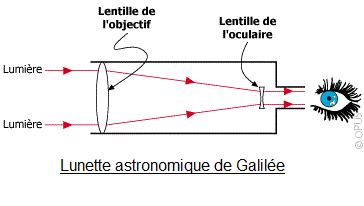
Astronomical telescope of Galilée
Galilée's first telescope is composed of a main tube and two minor sections, in which the objective and the eyepiece * are placed. The main tube consists of two semi-circular tubes held together by a copper wire and covered with paper. The lens is biconvex * and measures 51 millimeters in diameter, but the radii of curvature of the surfaces are not the same; the focal length is 1330 millimeters, the thickness at the center of 2.5 millimeters. The eyepiece is plano-concave and measures 26 millimeters in diameter; the concave side has a curvature radius in the direction of the eye of 48.5mm; its thickness in the center is 3 mm, the focal length of -94 mm. This instrument can magnify objects 14 times and has a visual field of 15 '.
Galilée's second bezel consists of a main tube, at the end of which are inserted two distinct sections, carrying the objective and the eyepiece. The tube, made of joined strips of wood, is covered with red leather (turned brown over time) adorned with gold friezes. The plano-convex lens, with a convex side outward, measures 37 millimeters in diameter, has an aperture of 15 millimeters, a focal length of 980 millimeters and a thickness in the center of 2.0 millimeters. The original eyepiece was lost and it was replaced in the 19th century by a biconcave eyepiece 22 millimeters in diameter, whose center thickness is 1.8 mm and the focal length of -47.5 millimeters. The instrument can magnify objects 21 times and has a visual field of 15 '
Unlike the astronomical telescope, the image is straight. It is viewed from an angle larger than the object.
 |  |  |
|---|
Biconvex *: which offers two opposite convex sides
Ocular *: In a compound optical instrument, lens or lens system in front of which the eye is placed.